Loading...
How to set your per-minute rate on Orum
Your rate is compared alongside your reviews, never on its own. How to work out your real income from the 40 % share, what to charge before you have reviews, and when to raise it.
By Equipo Orum

Setting your rate is the first business decision you make on the platform, and the most misread. Price is never read on its own: the client sees it next to your reviews, your speciality and your availability status, and decides on all four at once.
Start from your real income, not your rate
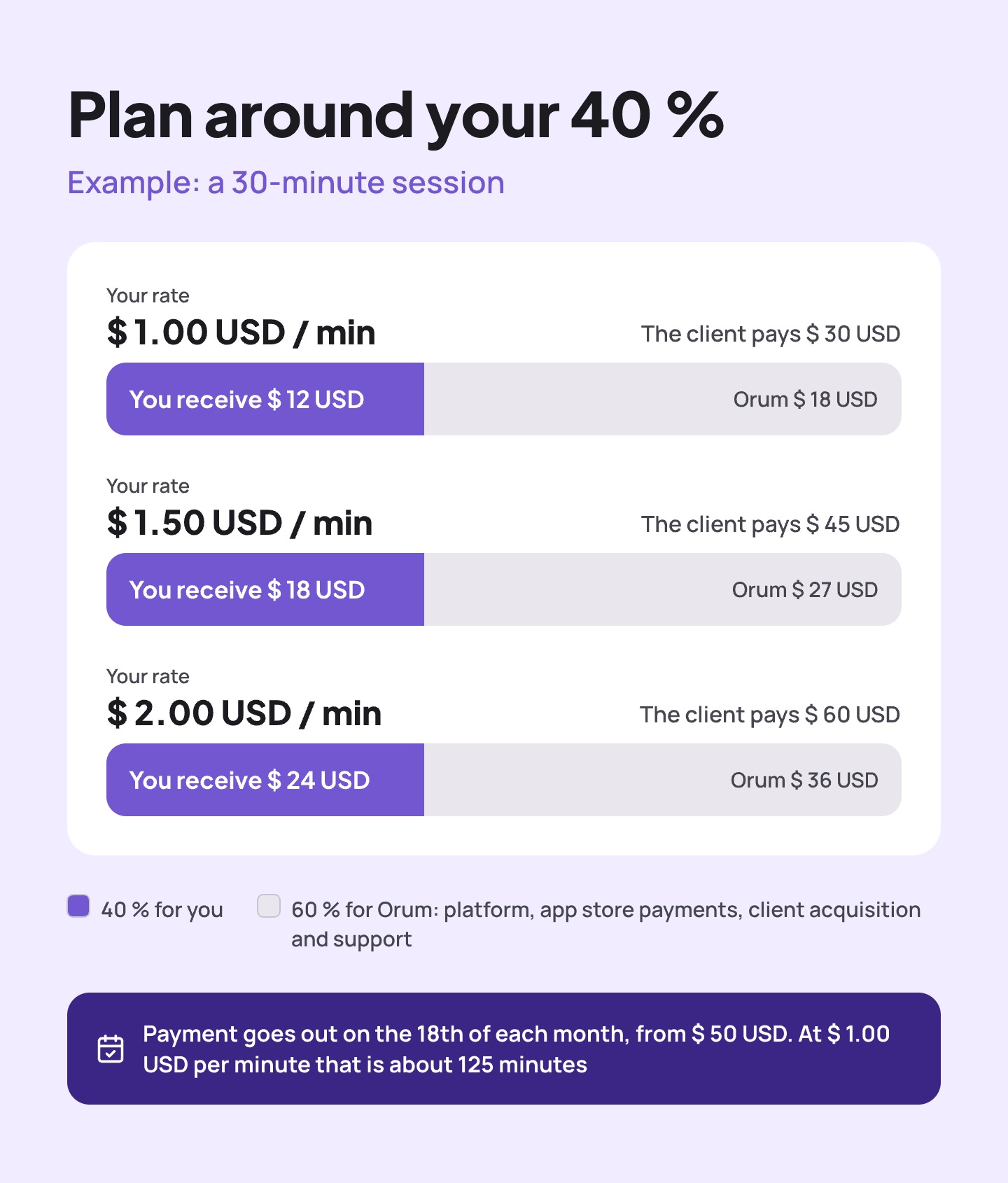
The platform minimum is $ 1 USD per minute and you decide how far above it you charge. But you receive 40 % of what the client pays, so that is the figure worth planning around.
| Your rate | Client pays (30 min) | You receive | | --- | --- | --- | | $ 1.00 USD | $ 30 USD | $ 12 USD | | $ 1.50 USD | $ 45 USD | $ 18 USD | | $ 2.00 USD | $ 60 USD | $ 24 USD |
From there you can work out how many minutes a month you need to reach the $ 50 USD payout minimum: at $ 1.00 USD per minute, about 125 minutes of consultation.
What to charge when you have no reviews
With no reviews, your price is the only signal a client can read, and a high signal with nothing behind it reads as risk rather than quality.
While you build a reputation, a moderate rate converts better. Not because cheap attracts, but because it lowers the cost of trying you: someone risks five minutes with you far more easily than twenty.
When to raise it
Three signs your rate is too low:
- Your sessions fill up during the hours you are online.
- You have enough reviews that a client compares you on more than price.
- Your consultations run longer because people come back, not because you are slow to answer.
You can change your rate whenever you want. The change applies only to new sessions, never to ones that already happened, so raising it affects nobody who has already talked to you.
The most expensive mistake
Raising your price to make up for low demand. If you are getting few consultations, the cause is almost never the rate: it is usually the hours you spend online, an incomplete profile, or too few reviews. Raise your price when demand exceeds your time, not when it falls short.